I like birds and birding. My wife and I maintain a lot of feeders around our home, which allows us to observe each species in different ways. Over time, we have developed relationships with family units that stay here or return each year. This is important to me. I have always felt a deep but respectful connection with creatures in the wild.
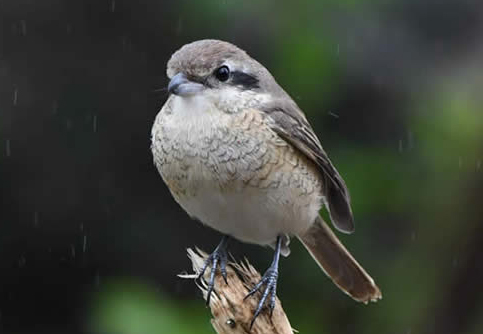
The photograph is of a Brown Shrike. It was taken by Dr. Callyn Yorke at the Son Tran Mountain wildlife preserve on a rainy day in Da Nang, 2017. (http://avconline.avc.edu/cyorke/Vietnam2017.html)
The warm, spring morning felt familiar, yet with a hint of something no longer distant in memory. I took note but just proceeded with the usual weekend routine. I made coffee. I fed the cats and dogs.
My night-owl wife slept best from two until ten, so I left her a quiet house by leading our pets to the deck after they ate. Outside, the air was humid and still.
Taking a deep breath, I detected a faintly salty, petrochemical note in addition to our backyard’s earthy, floral aroma. The scent intrigued me but I couldn’t place it. The aroma of hot coffee vied for my attention, anyway. I took a sip and gazed down the stone path that wound through the fresh green of our abundant little Eden.
A chickadee swooped by, very near my head. It flew directly to a bird feeder hanging in the smoky shadows of an Ashe juniper. After grabbing a sunflower seed, it hustled back into nearby foliage.
There’s no telling how often I’ve observed that ritual, but this time it brought a blurry moment from my past into focus.
I recalled a Cobra gunship flying so low I could see the pilot’s face. It was tracing the gentle curve of China Beach, a well-guarded rest and recreation area for American servicemen in Vietnam during a war fifty years ago. Below it, some of my squadron mates played shirts and skins football. The rest of us lounged in the sand, digesting a Fourth of July picnic of grilled steaks, baked beans, and coleslaw.
My friend Gene and I lazily monitored the Cobra as it flew by.
“Man, this feels good,” he said.
I nodded in agreement. Our teenage bellies were full and the day was sunny with only a few puffy clouds and a reliable, somewhat cool breeze from offshore. If we were at our hangar five miles inland, we would have been suffering in stifling, windless heat.
All of sudden, the ocean breeze faded to nothing and humidity wrapped around us like a steaming hot tortilla. This got everyone’s attention. We knew a tropical thunderstorm would soon blow in.
Without discussion, the entire squadron packed up and slogged across the toasty, coral sand towards the road just beyond a scant tree line. Once there, we watched the senior officers pile into the squadron’s lone pickup truck and drive away. The olive drab school bus scheduled to transport the rest of us was not due for another hour.
The pickup was barely more than a minute gone when gale-force winds hit hard, toppling a palm tree a little way down the beach. Thick, dark clouds quickly turned the bright day into a dim twilight.
There were more airmen than could fit under the nearby cabana, so Gene, myself, and a few more ran to the single remaining wall of a cinderblock structure not far away. We hunkered down, backs against the wall, just as rain exploded from the sky. The wind was so violent that even with no roof over our heads, we were somewhat protected in the leeward bubble.
Nearby, a little gray bird fluttered vainly against the wind and rain. It looked tired and in physical danger from being repeatedly thrown to the ground by the tempest.
My small group edged away from the distressed creature with the unspoken hope it would seek refuge in our sanctuary. Suspicious, but not too hesitant, the bird hopped into our pocket of calm.
As we all settled in for the storm, I assessed our little gathering. It occurred to me that all of us, man and beast, were kind of equal now, quietly watching the fury of nature with ancient animal eyes.
After fifteen or twenty minutes, the squall passed. Light began to return. We damp, chilled airmen stirred as our shelter mate hopped out into the ever more gentle rain. It swiveled its tiny head, carefully looking us over.
The bird’s black eyes sparkled in the returning light. At that moment, for an instant, I felt connected with it in a way that neither feathers, nor brain size, nor any idea about humanity’s special place in the world could deny.
I had a strong sense that it appreciated our generosity.
Deftly shaking off the rain, the gray bird launched itself up into the air, free again to fly wherever it wished. Mere seconds later, it disappeared into a sky turning bright and silvery.
“Goodbye, my friend,” I said, “May good weather be yours forever.”
I turned to join the others but they were standing motionless, looking at me.
Gene asked, “Talking to the bird?”
“Kinda,” I replied.
“Crazy,” someone muttered.
“Not ‘less the bird talked back,” Gene said.
We all laughed for a second before sinking into an uncomfortable silence.
Plodding through the wet sand on our way back to the cabana, I told Gene that I really did feel like the bird thanked us.
“Me, too,” he said, “But, from now on, remember, we didn’t talk to no bird.”
I shut up and tried to stop thinking like that. Empathetic communication with other species, no matter how subtle, was not part of a teenage airman’s reality in 1970. To be sane, at least to appear sane, I was obliged to accept the reality of my peers.
We gathered near the cabana with the rest of our squadron. Laughter and ribald talk of food and football broke the post-storm quiet.
Soon however, Gene and I completed the betrayal of our senses and presumed sanity. When the bus arrived, we clambered aboard. We let it take us back into war.